
Self-Ref Cards
“Self-reffable” cards are a key component of Drift. The principle is to allow players to engage in interactable gameplay with the environment without the prerequisite of an attending referee to administer gameplay.
Self-ref cards might be found anywhere – but in many cases, will be attached to a phys-rep; a prop, door, or inside a room. If the self-ref card is attached to a movable object (for example, a prop), players may move the prop with the self-ref card to study later.
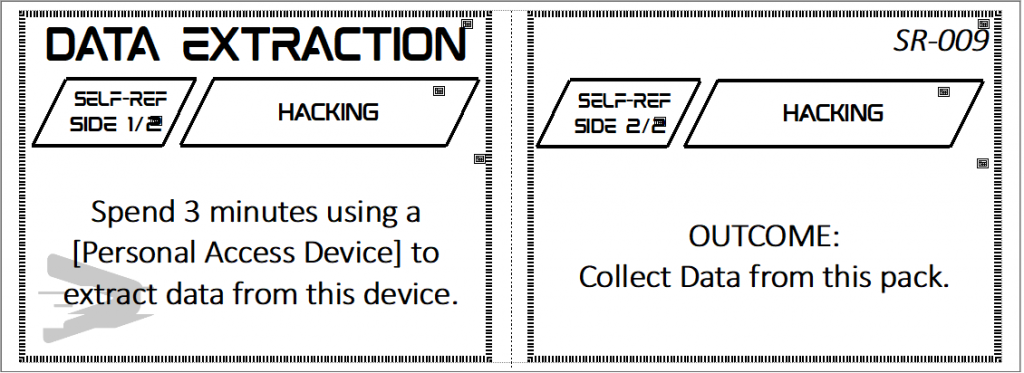
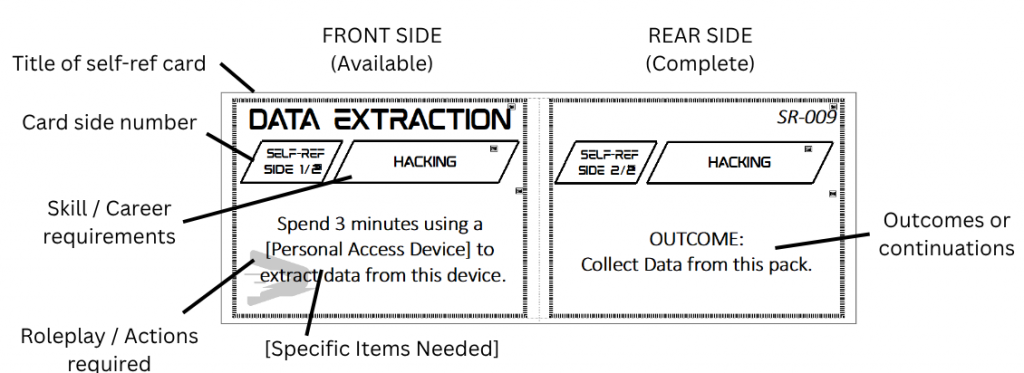
Side Number
Self-ref cards are typically designed with a specific content order denoted on the card(s) so that they can be performed in sequence and reveal information or other outcomes. The side number is used to provide instructions for progressing through the sequence of the self-ref card.
Requirements
The requirements box on a self-ref card states specific career or skill requirements that are needed in order to interact with that self-ref card. If a character looks at a card, and does not meet the self-ref requirements, they can infer what skills might be required in order to interact with it, and seek out another character IC with those prerequisites. For example, a Medical II character sees a self-ref card which lists Scientist I as a requirement. The observing character should not read the card, but might note that there’s something here that a Scientist I might be able to interact with, and can look for someone with Scientist I.
Actions
Actions are instructions on the card to progress the card. This might be “Spend 5 minutes reviewing the map” or “Consume a [Repair Patch] to mend the leak”. Involved characters should perform the actions in order to progress.
Note that many roleplay actions have a duration assigned to them – whilst exact timing is not required, this is provided as guidance for how long players should roleplay this stage of the card. This time might be written directly as “Spend 5 minutes reviewing the map” or “Review the map (5 minutes)”. These are functionally equivalent wordings.
Where a self-ref card refers to an item in square brackets, eg. [Welding Torch], this indicates that a specific IC item is required (lammied). Any rules on the item lammie must be adhered to, including any additional skill requirements.
Actions can be paused and resumed at any time, in which case they should be continued where they left off, provided all the requirements are still met.
Outcomes
Each self-ref card will have a final ‘OUTCOME’ statement. This is the end of the self-ref card, and will describe the outcome of the character actions.
Where a self-ref card has multiple solution paths, these will usually lead the characters to a specific outcome. Under no circumstances should players take a different outcome which might have been available if they had chosen a different path – this will be considered cheating.
The outcomes may list specific rewards. Typically these might be one or more lammied item cards, intelligence information, or expertise points. In most cases, the reward will be included with the self-ref card, unless explicitly stated otherwise (eg. ASK A REF). In some cases, there may be additional rewards present with the self-ref card. Players should take ONLY the rewards stated on the card applicable. Taking additional rewards will be considered cheating.
In order to indicate a self-ref card has been completed, after completion, players should leave the self-ref card turned with the OUTCOME visible.
Self-ref cards are intended to be as easy to operate as possible – just remember to read the card in order as written, and once a path has been chosen, stick to that solution path. In case of any doubt, speak to a referee for guidance or clarification.